SHOP SILKWOOD
IMDb >
Silkwood (1983)
Quicklinks
Top Links
trailers and videosfull cast and crewtriviaofficial sitesmemorable quotesOverview
main detailscombined detailsfull cast and crewcompany creditstv scheduleAwards & Reviews
user commentsexternal reviewsnewsgroup reviewsawardsuser ratingsparents guiderecommendationsmessage boardPlot & Quotes
plot summaryplot synopsisplot keywordsAmazon.com summarymemorable quotesFun Stuff
triviagoofssoundtrack listingcrazy creditsalternate versionsmovie connectionsFAQOther Info
merchandising linksbox office/businessrelease datesfilming locationstechnical specslaserdisc detailsDVD detailsliterature listingsnews articlesPromotional
taglinestrailers and videospostersphoto galleryExternal Links
showtimesofficial sitesmiscellaneousphotographssound clipsvideo clipsSilkwood (1983)
| Photos (see all 24 | slideshow) |
Overview
Release Date:
14 December 1983 (USA) moreTagline:
On November 13, 1974, Karen Silkwood, an employee of a nuclear facility, left to meet with a reporter from the New York Times. She never got there.Plot:
The story of Karen Silkwood, a metallurgy worker at a plutonium processing plant who was purposefully contaminated, psychologically tortured and possibly murdered to prevent her from exposing blatant worker safety violations at the plant. full summary | add synopsisAwards:
Nominated for 5 Oscars. Another 2 wins & 7 nominations moreUser Comments:
Fear on many levels moreCast
(Cast overview, first billed only)| Meryl Streep | ... | Karen Silkwood | |
| Kurt Russell | ... | Drew Stephens | |
| Cher | ... | Dolly Pelliker | |
| Craig T. Nelson | ... | Winston | |
| Fred Ward | ... | Morgan | |
| Diana Scarwid | ... | Angela | |
| Ron Silver | ... | Paul Stone | |
| Charles Hallahan | ... | Earl Lapin | |
| Josef Sommer | ... | Max Richter | |
| Sudie Bond | ... | Thelma Rice | |
| Henderson Forsythe | ... | Quincy Bissell | |
| E. Katherine Kerr | ... | Gilda Schultz | |
| Bruce McGill | ... | Mace Hurley | |
| David Strathairn | ... | Wesley | |
| J.C. Quinn | ... | Curtis Schultz |
Additional Details
Parents Guide:
View content advisory for parentsRuntime:
131 minCountry:
USALanguage:
EnglishColor:
Color (Technicolor)Aspect Ratio:
1.85 : 1 moreSound Mix:
MonoCertification:
Iceland:16 | Australia:M | Singapore:NC-16 | Argentina:18 | Chile:18 | Finland:K-12 | Sweden:11 | UK:15 | USA:R | West Germany:16MOVIEmeter: 
Fun Stuff
Trivia:
The scene where Silkwood set off the radiation alarms actually happened. Her level of contamination was forty times the safe limit. moreGoofs:
Continuity: When the house is plundered by men looking for radiation, Karen and Dolly are questioned and then Dolly is taken away. But not long afterward, in a close shot of Karen, you can see Dolly in the background. moreQuotes:
[on the deceased former workers of a nuclear plant]Angela: They all look as though they died before they were dead.
more
Movie Connections:
Referenced in "Mystery Science Theater 3000: Operation Double 007 (#6.8)" (1993) moreSoundtrack:
Amazing Grace moreFAQ
This FAQ is empty. Add the first question.more
Message Boards
Discuss this title with other users on IMDb message board for Silkwood (1983) moreRecommendations
If you enjoyed this title, our database also recommends:
Show more recommendations
![]() |
![]() |
![]() |
![]() |
![]() |
| The Plutonium Incident | The China Syndrome | K-19: The Widowmaker | The Pentagon Papers | Higher Learning |
|
IMDb User Rating:
|
IMDb User Rating:
|
IMDb User Rating:
|
IMDb User Rating:
|
IMDb User Rating:
|
Related Links
| Full cast and crew | Company credits | External reviews |
| News articles | IMDb Biography section | IMDb USA section |
| Add this title to MyMovies |


Anytime someone asks me what I'd consider the scariest movie ever, I say "Silkwood," and they say "But that's not a horror movie."
No?
There is so much to fear here, and scariest of all, probably, is the fact that the title character lived just a few decades ago, in modern-day America.
There is the fear that comes from living in poverty, or right on the edge of it. Silkwood, her cohorts, and most of her coworkers have little education; they live humble lives of church revivals, rebuilt cars, and "mystery meat" sandwiches brought for lunch in brown paper bags. The nuclear plant where they work is the only game in town (or the entire state), in terms of wages and benefits. And so, every day, they live in fear of losing their jobs. They have spent their lives being instructed to trust authority and submit to it. They are intimidated by the managers and supervisors who frown on camaraderie, and positively scowl on their labor union.
There is the fear of the unknown at the plant -- trucks being dismantled and buried behind barbed wire, under guard and under cover of darkness. Management gives the workers the minimum amount of information they need to perform their jobs, and often withhold or disguise facts that are essential to their very survival.
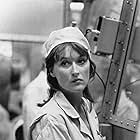
Karen, a somewhat rebellious, less-than-conscientious worker, is shocked into activism when her co-worker Thelma, becomes exposed to radioactive contamination, or "cooked." For me, this sequence is one of the most disturbing. Thelma is probably only in her 40s, but she looks like she's ready for retirement, due to the hard life she has lived. Her daughter is dying of cancer, and she herself wears wigs most days, because her hair is falling out. It's hard to watch the weeping, pleading Thelma being forcibly scrubbed head to toe with a stiff brush, water being shot into her eyes and nose, in a dubious attempt to "decontaminate" her. She is then patronized by a doctor who straight-facedly assures her that she has only superficial exposure and will be just fine.
There is fear when Karen sticks her neck out -- talking to union reps, traveling to Washington, and being sent back to work with a dangerous assignment: to gather evidence. At one point in the film, absolutely no one is supporting her. Her roommate feels resentful and rejected; her boyfriend has moved out, jealous of her involvement with the sophisticated people from Washington, and her co-workers treat her like a pariah, afraid that being seen talking to her will brand them as troublemakers, endangering their jobs, or even their lives.
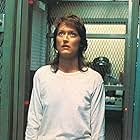
Their worries seem more and more valid as the movie progresses. She walks into a roomful of supervisors, and they all fall silent. Suddenly, every time she walks past a radiation monitor, the alarms sound and she, like Thelma, is dragged to the dreaded decon room, where her skin is scrubbed raw -- torture chillingly disguised as medical necessity. Even her home is no longer safe. Plutonium is found in a urine sample that she brings from home, and every item in her house--right down to the wallpaper--is emptied and taken away from her. Her stone-faced, smooth-talking boss is right there, encouraging her to sign a statement that will undoubtedly absolve the company of any responsibility.
The headlights Karen sees in her rear-view mirror are not the last thing we see that frightens us. It's her wrecked car being slowly towed past the restaurant where a union meeting is still in progress.
The movie hits so many of our fear buttons: Helplessness, loneliness, rejection, vulnerability, and finally, the bottom-line thing we all fear the most. The most encouraging note is the awareness that anyone who sees this movie will come away with. It's a blueprint for empowerment.
e.w.