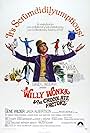
Willy Wonka & the Chocolate Factory
Quicklinks
Top Links
trailers and videosfull cast and crewtriviaofficial sitesmemorable quotes
Overview
main detailscombined detailsfull cast and crewcompany creditstv schedule
Awards & Reviews
user commentsexternal reviewsnewsgroup reviewsawardsuser ratingsparents guiderecommendationsmessage board
Plot & Quotes
plot summarysynopsisplot keywordsAmazon.com summarymemorable quotes
Fun Stuff
triviagoofssoundtrack listingcrazy creditsalternate versionsmovie connectionsFAQ
Other Info
merchandising linksbox office/businessrelease datesfilming locationstechnical specslaserdisc detailsDVD detailsliterature listingsNewsDesk
Promotional
taglines trailers and videos posters photo gallery
External Links
showtimesofficial sitesmiscellaneousphotographssound clipsvideo clips
  • The combination to the first door in the chocolate factory is 99-44/100% pure, which was an ad slogan for Ivory Soap.

  • Voted number 8 in channel 4's (UK) "Greatest Family Films".

  • The Tinker quotes from the poem "The Fairies" by William Allingham.

  • Among Wonka's lines are the following quotations: "Is it my soul that calls me by my name?" from William Shakespeare's "Romeo and Juliet"; "All I ask is a tall ship and a star to sail her by" from the John Masefield poem "Sea Fever"; "A thing of beauty is a joy forever" from John Keats's "Endymion: A Poetic Romance" and "Round the world and home again, that's the sailor's way!" from William Allingham's "Homeward Bound". "We are the music-makers..." is from Arthur O'Shaughnessy's "Ode", which also gave us the phrase "movers and shakers". "Where is fancy bred..." and "So shines a good deed..." are from William Shakespeare's "Merchant of Venice". The lines to the song "Sweet lovers love the spring time... " are from Shakespeare's As You Like It. "Candy is dandy, but liquor is quicker" is from "Reflections on Ice Breaking" by Ogden Nash. "The suspense is terrible, I hope it will last" is a quote from Oscar Wilde's "The Importance of Being Earnest". These literary quotations were not in Roald Dahl's original script. They were added for one reason or another by David Seltzer when he re-wrote the screenplay.

  • Peter Ostrum, who plays Charlie Bucket, made no other films. He later became a veterinarian. In fact, of all the Wonka kids, Julie Dawn Cole is the only one still acting.

  • Both Denise Nickerson (Violet Beauregard) and Julie Dawn Cole (Veruca Salt) had a crush on Peter Ostrum (Charlie Bucket). During filming, the girls would alternate days over which one would spend time with Ostrum. Bob Roe was also an object of attraction for the two. On the day they didn't get to spend with Peter, they would spend it with Bob Roe. Bob Roe was the son of first assistant director 'Jack Roe'.

  • Julie Dawn Cole (Veruca Salt) hated chocolate.

  • According to the DVD commentary, Julie Dawn Cole kept several props from the movie (when instructed not to) including the Golden Ticket, an Everlasting Gobstopper, and a Willy Wonka candy wrapper.

  • The length of Veruca Salt's hair becomes progressively shorter throughout the movie as the filmmakers kept burning off Julie Dawn Cole's split ends.

  • The scene of Veruca's "demise", was filmed on Veruca actress Julie Dawn Cole's 13th birthday, on 26 October 1970. In the DVD commentary, she said 'no one wished her a happy birthday' and Denise Nickerson starts singing.

  • After the company finished filming in Munich, Germany, the studio and locations were then taken over by the Cabaret (1972) people. On the DVD alt-track, one of the kids remarks, "We moved out and Liza [Liza Minnelli] moved in".

  • In the scene where Willy Wonka (Gene Wilder) drinks from a flower-shaped cup and then eats the cup, the cup itself was made of wax. Gene Wilder had to chew the wax pieces until the end of the take, at which point he spat them out.

  • The reactions of the actors in some scenes are spontaneous. For example, when the children first enter the main factory and see the gardens, their reactions are real, it was really their first view of that particular set.

  • A number of the objects and plants in the main factory really were edible, including the giant lollipops.

  • The film was originally financed by the Quaker Oats Company. They hoped to tie it to a new candy bar they intended to bring on the market. When the film was released, the company began marketing its "Wonka" chocolate bars. Unfortunately, an error in the chocolate formula caused the bars to melt too easily, even while on the shelf, and so they were taken off the market. Quaker sold the brand to St. Louis based Sunline, Inc. (which later became part of Nestlé via Rowntree) not long after this; Sunline was able to make the brand a success, and Wonka-branded candy (most of which isn't chocolate-based) is still available in the USA.

  • The opening credits sequence was filmed at a real chocolate factory in Switzerland.

  • The scene where Augustus Gloop was interviewed for being the first Golden Ticket finder was shot at a real German restaurant. Most of the cast members went there for lunch during the time the movie was being filmed.

  • The little scene with Charlie and his mom before the "Cheer Up, Charlie" song was filmed at 1:00 in the morning.

  • Most of the small walk-on parts in this movie were played by German people.

  • Before Wonka does his little somersault, he sticks his cane into a brick made of Styrofoam.

  • The bees that were used in the gum machine were actually wasps. Paris Themmen, a notorious troublemaker on the set, apparently let them out of their bell jar and was stung on the face.

  • The final Oompaloompa song took a total of 50 takes.

  • Joel Grey was first choice for the role of Willy Wonka but was not considered physically imposing enough. The role was then offered to Ron Moody who declined it. Roald Dahl's original choice to play Willy Wonka was Spike Milligan. Jon Pertwee had to turn down the role because he was in the tight schedule of "Doctor Who" (1963) at the time. All six members of Monty Python (Graham Chapman, John Cleese, Eric Idle, Terry Gilliam, Terry Jones and Michael Palin) had all expressed great interest in playing the role, but they were deemed not big enough names for an international audience. Cleese, Idle and Palin would be seriously considered for the same role in Charlie and the Chocolate Factory (2005).

  • Jim Backus was the original choice for Mr Salt but he was considered too recognizable a figure.

  • After reading the script, Gene Wilder said he would make the film under one condition: that he would be allowed to do a somersault in the scene when he first meets the children. When asked why, Gene Wilder replied that having Willy Wonka start out limping and end up somersaulting would set the tone for that character. He wanted to portray him as someone whose actions were completely unpredictable. His request to do the somersault was granted.

  • During the "Wonka Wash" car scene, the foam used to spurt out was compiled from basic fire extinguishers, but what was unknown to the cast and crew was that the foam itself was potent skin irritant, so after shooting the scene, the actors were left in considerable discomfort when their skin puffed up and required several days to receive medical treatment and recovery.

  • Peter Ostrum went through puberty during the film. His voice is high during the duet of "I've Got A Golden Ticket", and is much deeper later in the film, such as during the bubble scene.

  • The song Wonka sings on the boat ride ("There's no earthly way of knowing... ") are the only song lyrics taken directly from Roald Dahl's book. All other songs were written specifically for the film.

  • The exterior of the chocolate factory was Munich's gas works.

  • The child named Winkelman is played by director Mel Stuart's son Peter Stuart. Also, a girl in the classroom is played by Madeline Stuart, the director's daughter. She was ten years old in 1970 and she suggested her dad undertake the project after reading the book. When she read the book, she suggested to her father that he approach "Uncle Dave" (producer David L. Wolper) with the idea of turning the book into a movie.

  • Jean Stapleton was the first choice to play Mrs. TeeVee (Mike's mother) but turned down the part in favour of doing a TV series pilot instead. That series was, of course, "All in the Family" (1971).

  • Roald Dahl was reportedly so angry with the treatment of his book (mainly stemming from the massive rewrite by David Seltzer) that he refused permission for the book's sequel, "Charlie and the Great Glass Elevator", to be filmed. Seltzer had an idea for a new sequel, but legal issues meant that it never got off the ground. Reportedly, Dahl was so unhappy that he refused to ever watch the completed film in its entirety. Once, while staying in a hotel, he accidentally tuned into a television airing of the movie, but reportedly changed the channel immediately when he realized what he was watching.

  • Most of the chocolate bars were actually made of wood.

  • Sammy Davis Jr. expressed an interest in playing Bill, the candy store owner, but the film-makers deemed it as too kitschy and declined. Nevertheless, the candy store song, "The Candyman", became a staple of Davis' stage show for many years.

  • This movie was shot in Munich, Germany, but the producers had to go outside of Germany to recruit enough little people to play the Oompa Loompas (one of the many tragic legacies of the Nazi era). Many of the people cast as Oompa Loompas (German or otherwise) did not speak English fluently, if at all. This is why some appear to not know the words to songs during the musical numbers.

  • Mike Teavee's father's line, "Not 'till you're twelve, son" took over forty takes to film.

  • The picture held up by the Paraguayan newscaster announcing the finder of the last golden ticket is of Nazi henchman Martin Bormann.

  • Jack Albertson (Grandpa Joe) appeared with Roald Dahl's wife Patricia Neal in the movie, The Subject Was Roses (1968). He won an Oscar for Best Supporting Actor for that film, defeating his co-star on this film, Gene Wilder, then nominated for The Producers (1968).

  • Ernst Ziegler, who played Grandpa George, was nearly blind, and so was instructed to look for a red light to guide him when his character was meant to be looking in a certain direction.

  • The face in the psychedelic tunnel movie is that of Walon Green, friend of director Mel Stuart and screenwriter of The Wild Bunch (1969). According to Stuart's memoirs, Green is the only person who would agree to let a centipede crawl on his face for the sake of a children's film.

  • The closing of the film was not scripted when filming began, so the director (Mel Stuart) had to call David Seltzer and ask him to think of something. Seltzer came up with the "happily ever after" bit in five minutes.

  • The musical code for entering the Chocolate Factory played by Wonka is the introduction of Mozart's "Marriage of Figaro". Mrs. Teevee mistakes it for "Rachmaninoff."

  • Veruca Salt's name is a slight variation on verruca - a wart. Seems appropriate, considering the character's personality. In the book, when learning the children's names, Willy Wonka mentions that verruca is a wart on the bottom of a foot.

  • This film was going to be titled "Candy Man" - hence the name of the song - but it was changed when it was realized that "Candy Man" was underworld slang for a drug trafficker.

  • The scene of Violet Beareguarde's demise where she swells up into a blueberry was done in two takes. Take one was pumping air into an inflatable suit and take two involved stuffing Denise into a two piece Styrofoam cut out. When rolling Denise around in her blueberry suit, the Oompa Loompas had a hard time controlling the rolling actress and would send her crashing into the wall several times.

  • Even thought the film didn't do as well in it's theater run, surprisingly when it went to home video it got more attention. Willy Wonka And The Chocolate Factory was one of the more popular movies for rentals by the time the rental fad took off in the 80s.

  • Since this was before the days of CGI, one of the visual effects that was needed to be accomplished was Violet turning blue. At the time, the development of color layering was in process. According to the book, Violet's face and hair turns blue. The director worked with it but was only able to turn her face blue. Further development of the color layering was perfected by the time the first Star Wars (1977) was released and was ready for use to make the light-saber concept look good.

  • The song Wonka sings on the Wonkamobile is "Ach so fromm"/"M'aparri" from Martha by Flowtow.

  • The country where the film takes place is a mystery. Various measures were taken: The cars do not have US license plates. The title of the newspaper is generic and does not reveal the name of the city. The identity of the coin that Charlie finds in the gutter is not revealed. After selling him a candy bar, the dealer does not state the exact balance due, as is customarily done in any transaction (but would disclose the unit of currency); he merely clears his throat. Mr. Wilkinson/Slugworth bribes Charlie with "Ten thousand of these", referring to units of currency, but does not use the name of the currency. Charlie never appears on television; the countries were all revealed during T.V. interviews. On the day they arrive at the Wonka factory, Charlie and Grandpa Joe are the only individuals not holding a flag of their native country. In the aerial scene at the end, cars are seen driving on the right. The film does not take place in the United Kingdom.


Related Links

Quotes Goofs Plot summary
Soundtrack listing Crazy credits Alternate versions
Movie connections FAQ Main details
IMDb daily poll IMDb trivia browser Search trivia section
Browse titles with trivia by letter
   A B C D E F G H I J K L M N O P Q R S T U V W X Y Z Other

You may report errors and omissions on this page to the IMDb database managers. They will be examined and if approved will be included in a future update. Clicking the 'Update' button will take you through a step-by-step process.